Field Notes Vol. 6 - The Crackle
The Crackle
Origins / Myth:
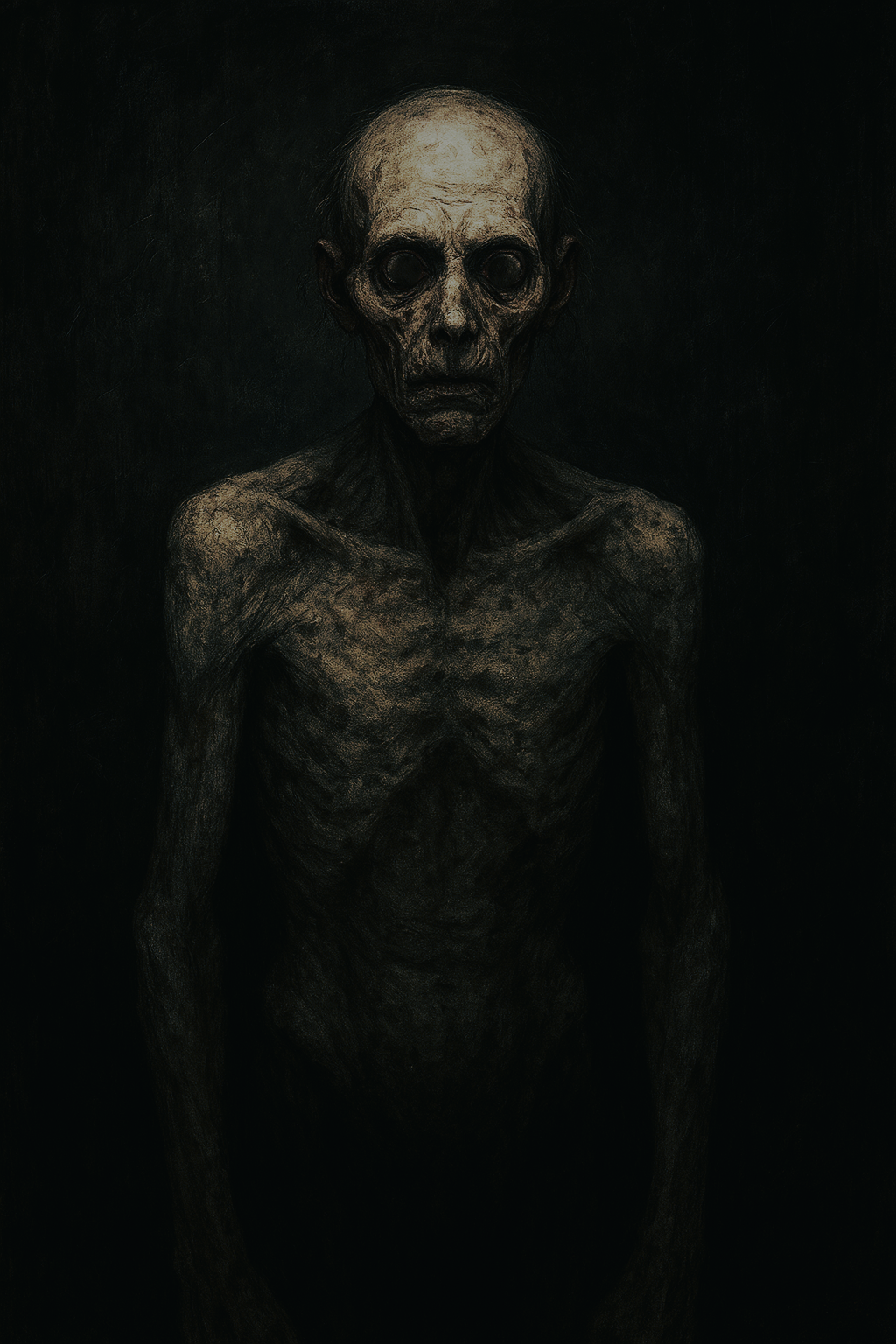
Whispered into existence along forest lines, derelict townships, and abandoned service roads, Crackle—sometimes called The Crackle—is a figure that slips between folklore and firsthand testimony. Myths describe a gaunt, corpse‑lean humanoid whose body moves with stiff, unnatural angles, yet whose eyes are unmistakably human. The contradiction between its skeletal frame and shockingly lifelike eyes forms a central theme in every retelling.
No consensus exists on what Crackle truly is.
Some traditions paint it as an immortal wanderer—once human, now twisted by isolation or starvation. Others call it an apparition that wears human eyes like borrowed ornaments, using them to mimic empathy while concealing a predatory instinct. A smaller subset of stories argue it is not one being, but a phenomenon: sightings of “Crackle” occurring wherever an area is in decline, as though the creature is drawn to entropy.
Its name derives from the most consistent hallmark of its presence:
a dry, brittle crackling sound, like old branches under weight—or bones adjusting. There is some similarities in this creature and the American south stories of Haints, and what they appear to look/act like in old texts.
Field Report:
There has been numerous occasions that A.P.I.S agents have had encounters with an entity matching the description above, but none of them have evolved into an altercation in which data could be maintained here at a level of vetting the council deems fit to be marked withe the A.P.I.S seal. Below is the Official A.P.I.S Field Report.
Entity / Creature Classification
Type: Unknown (Possible corporeal humanoid / parasitic entity / apparition)
Threat Level: Moderate–High
Justification: While no confirmed fatalities are attributed to Crackle, repeated accounts describe stalking behavior, prolonged observation of isolated individuals, and instances of the entity attempting to “learn” or mimic human movement. Witnesses report intense dread, loss of time, and intrusive thoughts following encounters. Lack of confirmed kills may indicate restraint—or simply a lack of survivors to report otherwise.
Known Regions Seen In:
Forest perimeters near abandoned rural infrastructure
Old farmlands undergoing foreclosure
Edges of small towns experiencing population decline
Suburban greenbelts during winter months
(Notes suggest Crackle avoids urban centers and high‑population areas.)
Signs of Presence / On‑Site Indicators:
Auditory Clues:
Rhythmic crackling, resembling:
Dry twigs
Old bones shifting
Knuckles being popped in rapid succession
Occasional soft inhalation sounds, as if testing the air
Intermittent bursts of static-like noise, especially near power lines
Visual Indicators:
Extremely tall, gaunt silhouette with elongated limbs
Unnaturally pale skin that appears dry or peeled in patches
Human-like eyes reflecting light even in total darkness
Jerky, puppet-like gait—pause–tilt–advance behavior
Appears to “reset posture” with rapid, uncomfortable jolts
Environmental Disturbances:
Sudden stillness: wind dies, insects quiet
Overhead lights or distant streetlamps flicker simultaneously
Dust or leaves lifting in upward spirals
Mild electromagnetic interference affecting phones/cameras
Behavioral Pattern:
Observation-first predator: watches at distance before approaching
Prefers isolated targets
Mimics human head‑tilts and gestures poorly, as if practicing
Retreats when illuminated directly but may circle around
Does not vocalize; breath is present but irregular
Preventative Measures:
Avoid prolonged stillness or isolation near known hotspot regions
Carry bright, high-lumen light sources
Maintain group travel—”The Crackle” rarely approaches pairs
Do not respond to mimicry (head tilts, slow waving, sudden shifts)
Avoid investigating unexplained crackling or static sounds after dark
Cameras with infrared capability may deter approach
Capabilities:
Enhanced sensory acuity: detection of movement and breathing at distance
Low-light vision: eyes adapt rapidly to darkness
Unpredictable movement speed: slow, stuttering walk punctuated by sudden, silent lunges
Learned mimicry: roughly imitates human posture or gestures
Environmental influence: minor EM interference, potential psychological effects (fear, confusion, dissociation)
Strategy if Encountered:
Do not freeze. Crackle responds to stillness with approach behavior.
Shine bright light directly at the entity’s face — for possible repellent effect.
Move steadily toward populated or illuminated areas.
Avoid looking into its eyes. Prolonged eye contact correlates with reported time loss and disorientation.
Do not allow it to flank you. Crackle prefers circular stalking patterns.
If multiple individuals are present, maintain formation. The entity avoids cohesive groups.
Speculation:
Theories surrounding Crackle divide into three primary schools:
The Remnant Theory
Crackle is a former human—possibly a lost wanderer or starved settler—warped by isolation and environment until only instinct remains.The Parasite Theory
The body is merely a host. The true entity is the presence behind the human eyes, wearing flesh like a damaged suit.The Threshold Phenomenon
Crackle appears in areas nearing abandonment or collapse—acting as a harbinger or scavenger feeding on the emotional or societal decay.
More troubling accounts claim there is never just one Crackle. Differences in height, posture, and eye color between sightings imply multiple entities, or one being that shifts form over time. Be wary agent.
Shoutout to Samuel Brower’s book series Haint’s Holler for the inspiration for this entry! Check it out here!