The Saucer in the Sky - An Original Short Story by Josh
I’m still trying to fit what happened last Monday into a shape my mind can hold. It was only a few days ago, but it feels like it happened to someone else—someone I watched from far away. Since then, sleep hasn’t been rest. It’s been a place the night keeps finding me.
We were at the lake with the same small circle of friends I’ve had since we were kids, at the same turnout we’ve claimed for years. Monday nights after work, we’d come out here to let the week loosen its grip—shoes off, backs against the hood of a car, the water doing what it always does: lapping, whispering, pretending the world is simple. It used to be my peaceful place. Now it feels like something that’s learned my name.
We got there around seven, when the sun is thinking about leaving but hasn’t committed yet. The air was cool enough to raise gooseflesh. Frogs throbbed in the reeds; crickets stitched a steady rhythm into the dark. We ordered our usual—two large pepperoni pizzas and a bottle of Mountain Dew—because we’ve been ordering the usual for so long it feels like part of the landscape. For the first hour, nothing felt wrong. The lake held the last light. The trees stood still. Even the shadows looked ordinary.
We’d barely finished the pizza when the first light appeared out over the water—small, steady, distant. For a few seconds we all watched it in the comfortable way you watch something that makes sense.
“Boat,” someone said.
“Has to be,” another answered, like saying it out loud could lock the idea into place.
It was a new moon, the kind of night that turns a lake into a black mirror. The light should’ve bobbed, should’ve drifted closer along the shoreline. Instead it swelled—too fast, too bright—until it washed our faces and bleached the world of color.
And then we realized it wasn’t on the water at all.
The brightness came from above.
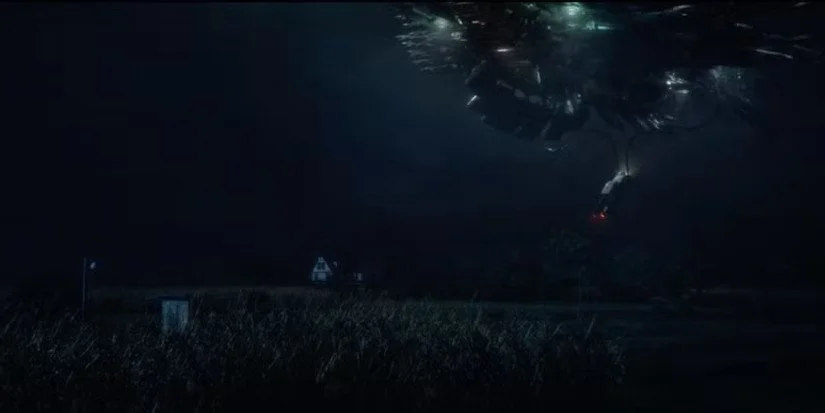
I remember squinting up and seeing a shape that didn’t belong in the sky: a huge, smooth sphere, rimmed with lights that rotated without casting any beam on the trees. It hung there silently, and for one impossible heartbeat it felt like the night was holding its breath.
The lights tightened—pinpointed—until they found us.
The beam hit like a hand closing around my throat. My legs locked. My jaw clenched. I tried to speak and nothing came out—not even a sound I could swallow back. Around me my friends stood the same way, eyes wide, mouths open, frozen in place like mannequins who’d forgotten how to fall.
The sphere moved. Not fast—just sure. It slid past the line of trees and over the field beyond the lake, and the grass below it bowed as if the air itself had weight. A soft, metallic hum crawled into my teeth.
Then it settled into the field and the hum stopped.
The light eased off us just enough that I could turn my head. We all could. That was the cruel part: our bodies were still statues, but our eyes were alive.
A seam opened along the side of the sphere. A ramp unfolded and kissed the ground.
Five figures stepped out.
They were humanoid in the way a scarecrow is humanoid—close enough to make you feel foolish for using the word. Tall, seven or eight feet, their limbs too long and their movements too deliberate. Their suits looked like space suits at first glance—smooth, armored, jointed in the right places—but the material caught the light like wet stone. One of them wore a suit a different color, darker, marked with a thin band of something that gleamed.
They walked toward us without hurrying, their boots making no sound on the dirt. The one in the different suit stopped at the edge of the turnout and tilted its head, as if listening to something we couldn’t hear.
Then, in clear, calm English, it said, “Don’t be scared. We are not going to harm you.”
I wanted to believe it. My body didn’t.
They reached us. Hands—gloved, impossibly strong—lifted us like we weighed nothing. Stretchers slid out from nowhere, or maybe they were already there and my mind just refused to see them until it had to. They laid us down, straps clicking into place across my chest and legs.
I tried to scream. I tried to kick. I couldn’t even blink on purpose.
They carried us up the ramp. The inside of the sphere looked larger than it should’ve been—space folding wrong, like a hallway that kept receding. Cold air brushed my face. I caught a glimpse of a surface that wasn’t metal or plastic, something pale and living, and then the edge of the doorway swallowed my vision.
I blacked out.
When I came to, I was alone in a room that pretended to be familiar—bright, sterile, wrong. The air stung with antiseptic, sharp as pennies and bleach. The lighting had no warmth to it, no direction; it flattened everything like an operating room that never slept.
My throat worked around the words before I could stop them. The sound came out thin and scraped raw, like my voice had been rinsed clean along with everything else. “I’m going to die here.”
No one answered, but something moved at my side. A gloved hand—smooth, cool, jointed wrong—took my forearm and turned it over as if reading it. A band cinched tight above my elbow with a quick, practiced tug. The pressure made my fingers tingle. I felt for skin and found only numbness spreading outward, as if whatever touched me carried its own anesthetic.
A needle slid in with no hesitation. Not painful—worse than painful—precise. My blood ran into a vial that clicked into place, and the machine gave a soft, satisfied beep. Another vial. Another click. Like an assembly line.
I tried to pull away and discovered my arm wouldn’t obey. The table’s restraints weren’t around me, but my muscles felt strapped from the inside. The gloved hand tapped a spot near the crook of my elbow and a cold patch bloomed there, adhesive pressed down with a firm, clinical pat. The gesture had bedside manner. That was the most terrifying part.
The air seemed to thicken. The light above me didn’t flicker, but my vision did—lagging behind, skipping like a scratched recording. My tongue felt too large for my mouth. When I tried to swallow, my throat clicked like dry plastic. I focused on the instruments, on the clean edges, on the hard certainty of metal, and still my thoughts slid away, smearing and pooling until I couldn’t tell what I’d already seen from what I was about to.
Then everything went out again.
I woke on the gravel by the lake with my friends scattered around me, blinking up at the trees like we’d all been dropped. The night was the same night—crickets still singing, frogs still calling, the water still lapping as if it hadn’t noticed a thing. My phone said only minutes had passed.
But my body disagreed. My mouth tasted like pennies. When I pushed myself up, my elbow stung, and I found a small square of clear adhesive pressed to my skin, perfectly centered over a pinprick. Under it, a bruise was already blooming, dark and tidy. My sleeves were rolled an inch higher than I remembered, as if someone had been careful not to wrinkle the fabric. My arms felt heavy, as if they’d been filled and drained.
None of us talked much. We didn’t need to. We just got in our cars and left the lake behind us like it might turn and watch.
That’s when the nightmares started.
In them I wake in the middle of a wide, open field under a sky with no stars. People stand around me—too many, packed close—and at first I think they’re just dirty and exhausted. Then my eyes adjust and I see the details my mind keeps trying to edit out: shaved patches of hair, small circular scars like punctures, neat rows of sutures that don’t match any hospital I’ve ever seen. Some of them have thin strips of gauze taped to their arms in identical places, the tape yellowed at the edges as if it’s been there for days.
They wear ragged clothes like prisoners, and they rock as they repeat the same words over and over: “They took us. They took us. They took us.”
I look down and I’m always in what I wore to the lake, right down to the stains on my shirt. The air smells like turned soil and disinfectant. When I flex my fingers, there’s a faint pull under the skin of my forearm, like a thread tightened and tied off.
Then I hear it—something running through the grass toward me. Fast. Heavy. Certain.
One of the figures breaks from the crowd and points, eyes shining like wet glass. “You’re going to be here forever,” it says, and the voice is almost human. Almost.
That’s when I jolt awake in my bed, lungs burning, sheets twisted around my legs. Every time, my body insists it’s over.
But in the dark, before my eyes adjust, I can still see the afterimage of a circle of light on the ceiling—perfectly round, perfectly bright—and I can’t shake the feeling that it isn’t an afterimage at all.